
In Part 1 of the Income Security In Retirement series, we introduced two different approaches to achieve secure lifetime income in retirement.
As a recap, we discussed the outcomes for Elisabeth, a healthy 70-year-old retiree who wants to allocate $100,000 from her investment portfolio to increase her secure lifetime income.
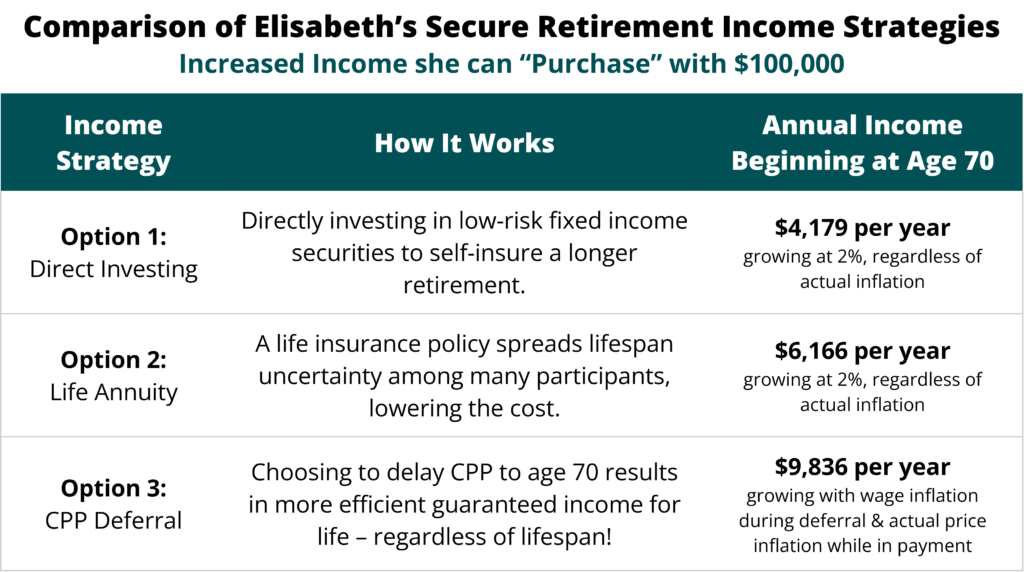
We also demonstrated that Elisabeth can overcome longevity risk and increase her guaranteed income by choosing a life annuity over a self-insured, direct-investment approach. While this increased her income by 48%, delaying her Canadian Pension Plan (CPP) benefits can offer even better terms.
CPP Deferral Adjustments – How They Work
As it turns out, on a dollar-for-dollar basis, the adjustments made when delaying CPP are significantly higher than what an insurance company can offer.
By default, the amount of CPP income you will receive is quoted based on the claim beginning at age 65. If you decide to begin receiving your benefits before or after age 65, CPP will make actuarial adjustments to account for either a longer or shorter payout period.
You can start receiving your CPP anytime between ages 60 and 70. If you start CPP before 65, your benefits are reduced 0.6% per month to account for a longer payout period. If you delay beyond age 65, your pension is increased by 0.7% per month. These adjustments allow Elisabeth to substantially increase her secure monthly income in retirement.
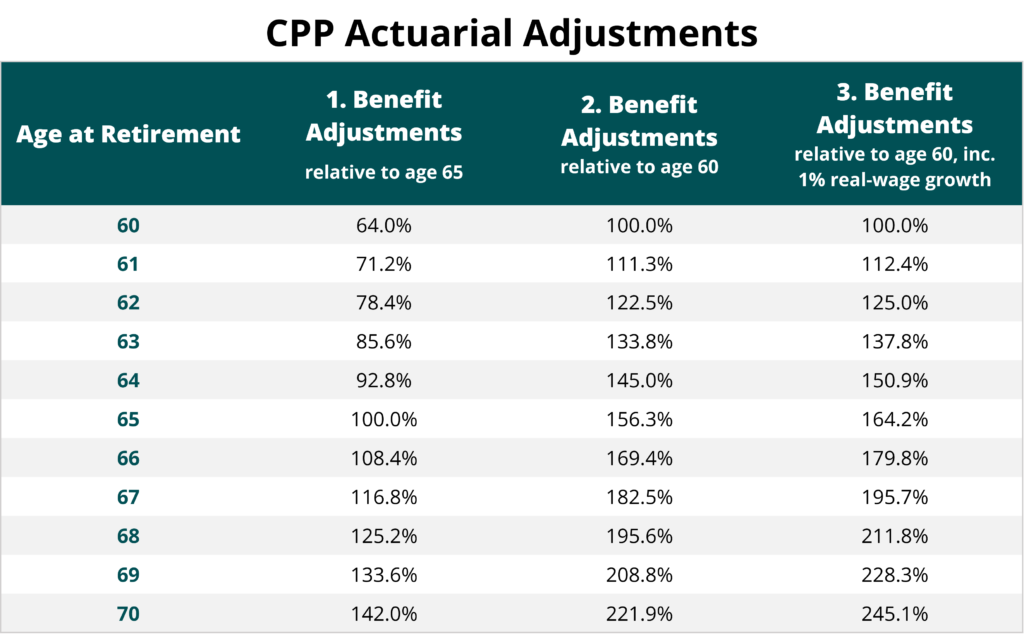
The following chart shows hypothetical benefit adjustments as defined by the CPP:
- The first column demonstrates the actuarial adjustments relative to what Elisabeth would receive if she had retired at age 65.
For example, if Elisabeth was entitled to $1,507.65 per month at age 65 (the maximum in 2026) but instead started CPP at age 60, she would receive only 64% of that amount, or $965 per month. If she waited until age 70, she would receive 142% of the age-65 payment amount, which would be $2,141 per month. These amounts are before inflation adjustments are taken into account. - In the next column, the adjustments are restated relative to the benefit amount at age 60. For example, if Elisabeth delays her benefits until age 70, she will receive 221.9% of the amount she would have received at age 60. Expressing the increase this way makes the value of delaying easier to appreciate.
- The final column shows the benefit adjustments relative to age 60, including increases for assumed real wage inflation, over and above price inflation, assumed to be 1% per year. For a more in-depth discussion about inflation, continue reading.
The bottom line: Elisabeth delaying CPP to 70 could result in a secure lifetime income that is 245% of what is available at age 60, once inflation adjustments are factored in.
Source: Government of Canada and QV Investors
The Cost of Delaying CPP from 65 to 70
Let’s say Elisabeth chooses to delay her retirement to age 70. By giving up five years of CPP, as shown by the red bars below, she will receive additional lifetime payments, as shown by the gold bars. Further, these payments are made for as long as Elisabeth lives, illustrated to the age of 106, the 99th percentile of her age at death.
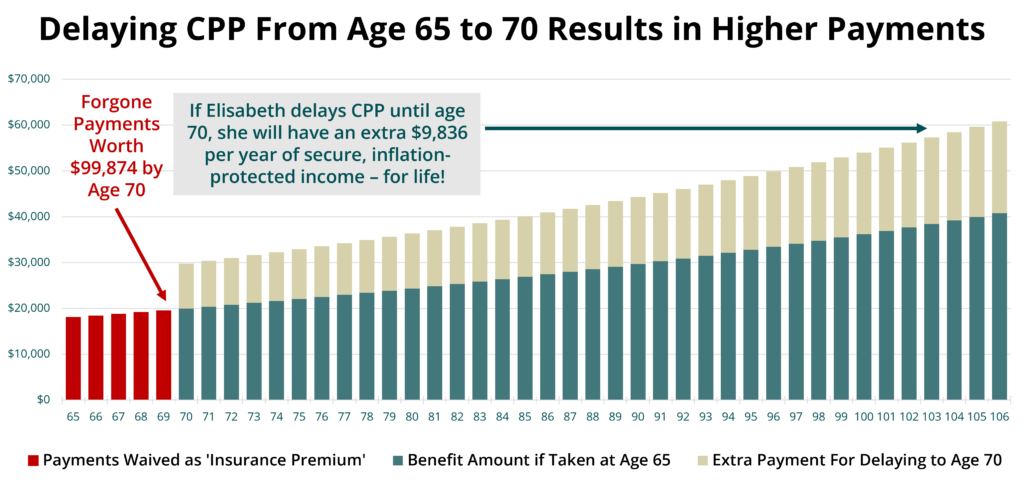
The forgone payments from 65 to 70, shown in red, can be considered the insurance premium Elisabeth paid for her additional secure lifetime income, beginning at age 70. The accumulated value of those premiums is worth close to $100,000 by age 70, while the additional pension amounts to an increased benefit of $9,836 per year for life.
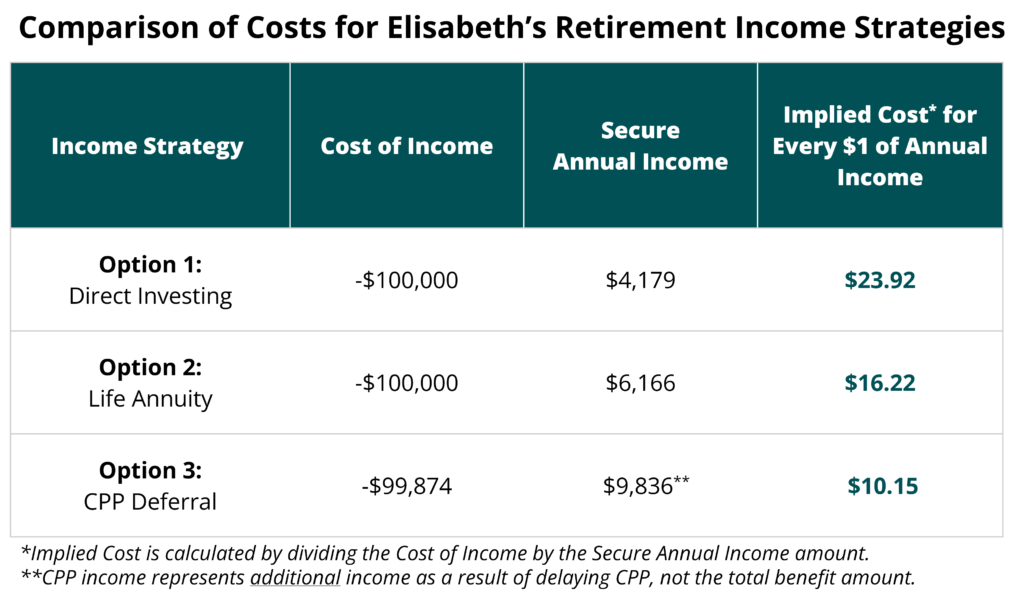
By delaying CPP from age 65 to 70, every dollar of additional annual income only costs Elisabeth $10.151 . However, the insurance company effectively values every dollar of income at an implied rate of $16.22 – meaning purchasing additional CPP is much cheaper than buying a life annuity.
Compared to the life annuity, Elisabeth will obtain 60% more additional income from CPP by delaying, and 135% more than with the direct investment approach!
CPP also provides inflation protection
As mentioned earlier, you can expect additional benefits from delaying CPP because of how inflation is accounted for both leading up to and during retirement.
Under the direct investing approach and the life annuity, Elisabeth’s retirement income was protected against a 2% expected inflation rate, regardless of the actual economic climate. CPP, on the other hand, can offer real inflation protection, in addition to a better payout.
During the delay period, CPP is adjusted for wage inflation, which is often higher than price inflation. For instance, if wages increase faster than prices by 1% per year, you will get about a 5% boost to your pension by delaying from 65 to 70.
The CPP also indexes pensions to the Consumer Price Index, protecting you from the possibility of a surge in the cost of living while in retirement.
That’s exactly what happened after COVID, when bungled supply chains and economic stimulus pushed inflation well above 2% per year. From 2022 to 2026, CPP pensions were increased between 2.0% and 6.5% per year, for a cumulative increase of 19.5%. On the other hand, 2% fixed increases would have only resulted in a cumulative increase of 10.4%.
So why don’t more people delay CPP to age 70?
First, let me state that there are good reasons not to delay CPP. Some people are forced to draw CPP at age 60 due to insufficient savings, impaired health or other circumstances that could make waiting uneconomical.
Second, there could be a perception that the CPP is unreliable, so people want to get CPP “while they can” and for as long as they can. Although it was once true that the CPP was unsustainable, reforms in the 1990s put CPP on a better path.
There are also problematic narratives that cause an early-claiming bias, such as thinking you may die before you break even; that you can earn better returns elsewhere despite not having a better risk-free option; and preferring an immediate gain over a more secure benefit later on. For a good summary, you can read Part 3 of the National Institute of Ageing’s series on 7 Steps Toward Better CPP/QPP Claiming Decisions.
More recently, there have been encouraging developments in CPP claiming behaviour. The percentage of Canadians who delay until age 70 has increased from less than 1% in 2015 to almost 8% in 2025. The CPP’s Chief Actuary expects this trend to continue.
While delaying CPP is not appropriate for everyone, most Canadians in reasonable health who can afford to wait should seriously consider doing so as a part of their retirement plan.
A big decision
Not all sources of secure income offer equal value. Self-insuring requires retirees like Elisabeth to plan for the possibility of living far beyond life expectancy, which lowers the amount they can safely spend. Life annuities improve outcomes by pooling longevity risk across many people. But delaying CPP is even more attractive because it increases lifetime, inflation-protected income at a relatively low implied cost.
Ultimately, the right CPP decision depends on personal circumstances, but the broader lesson is clear: secure income is most valuable when it is reliable, inflation-protected and efficiently priced.
- $99,874 ÷ $9,836 = 10.15 ↩︎