Written by the Canadian Small Cap team: Amit Shah and Amir Yazdani
For most of our collective memory, Canada and the United States have aligned on economic policy, trade and political efforts. Decades of partnership, a natural outcome of geography, have produced a deep and, for the most part, productive mutual reliance. Canada provides critical natural gas and electricity to parts of the US, fuels US Gulf Coast refineries with heavy crude, supplies auto parts to American auto manufacturers, and provides other critical materials like potash, uranium, and agri-food. In turn, Canada depends on the US as its largest customer, accounting for ~70% of merchandise exports.
Some of the historical alliance is now unravelling as the recent trade conflict undermines arrangements both countries had come to regard as permanent. Canada is the smaller partner by a wide margin, with an economy that is roughly one-thirteenth the size of the US, making it the more exposed of the two. In the face of this vulnerability, Canada is moving toward greater productivity by attracting capital, deploying fiscal spending on capital projects, and diversifying trade relations. These measures may soften the blow of a further escalation in trade conflict with the US and, in the longer term, make the country more resilient. Streamlining the regulatory bottleneck for approving nationally significant projects and, more recently, introducing favourable tax treatment for capital investments are some of the measures that may help attract foreign capital to Canada and support economic growth. Similarly, over $300 billion in combined public commitments and referred project capital over the next five years across defense, energy, housing, and infrastructure will also improve economic prospects.
Canada is Responding from a Position of Strength
Canada’s fiscal position remains a key competitive advantage. Net debt, which excludes public pension assets, stands at just ~10% of GDP, versus 136% for Japan, while the country’s deficit, including debt servicing costs, is just 2.7% of GDP (vs 5.8% in the US). This is reflected in favourable credit ratings, with Canada being one of only two G7 countries (Germany is the other) rated AAA by both S&P Global and Moody’s.
Canada is also working towards broadening its trade partnerships. There has been a flurry of recent activity on this, such as becoming the only non-European member of Security Action for Europe, negotiating a bilateral trade agreement with the United Arab Emirates, and establishing a free trade agreement with Ecuador. As Canada seeks strategic economic allies to diversify trade partnerships beyond the US, it helps that other affected countries are willing to cooperate. And to the extent that Canada builds out infrastructure like pipelines and export terminals that support more trade with other countries, the economic benefit could be meaningful. For example, facilitating more crude oil exports to other countries may help reduce the Western Canadian Select differential, similar to the narrowing observed after the Trans Mountain Pipeline was built, which added an estimated $4-5 billion in annual industry revenues.
Built to be Resilient, Not to be Right
If this capital cycle plays out, longer-term earnings should accrue to the companies doing the building, which is where the QV Canadian Small Cap Strategy is positioned. Within the portfolio, there is exposure to the energy value chain (across production, servicing, royalty, and processing and export), defence, and industrials (spanning engineering consulting and logistics). Importantly, fiscal spending is an additional tailwind to these companies and not part of our base assumptions for realizing attractive long-term risk-adjusted returns.
While fiscal spending may be a longer-term tailwind, deteriorating trade between the US and Canada poses a near-term risk. We note that many of our holdings, including Definity Financial Corp., Pet Valu Holdings Ltd., A&W Food Services, and Leon’s Furniture Ltd., are domestic-only businesses with no material exposure to US tariffs. Among the holdings that do have significant US exposure, several are well positioned to withstand higher tariffs. For example, Stella-Jones Inc. and Lassonde Industries Inc. each generate more than half of their sales in the US. However, both benefit from local economies of scale, with manufacturing and distribution networks that are already regionalized and US demand that is served primarily from US facilities. After navigating the volatility around Liberation Day, the management teams of these portfolio holdings now have a deeper understanding of their global supply chains with contingency plans in place, positioning them to act even more nimbly in the future. Aritzia Inc., for example, cut Chinese manufacturers from roughly a quarter of its sourcing mix to low single digits within months of US tariffs on China. Tariffs on China also hit US competitors, which must rework their own supply chains, so the playing field stays level. Across these names, leading market share in essential products also supports the ability to pass tariff-related cost increases through to customers.
Generally, we are not predicting macro outcomes and are instead building the portfolio to be resilient across a number of different downside scenarios. Resilience comes from selecting high-quality franchises that can protect and grow market share through tough scenarios, rather than from a view on how the trade conflict resolves. For example, Winpak Ltd. sells packaging to consumer goods companies and is trading at a meaningful valuation discount relative to both its long-term average and its larger peer, Amcor. Moreover, it holds $460 million in net cash while generating over $100 million of free cash flow annually, giving it ample capacity to deploy capital counter-cyclically if the economic environment worsens.
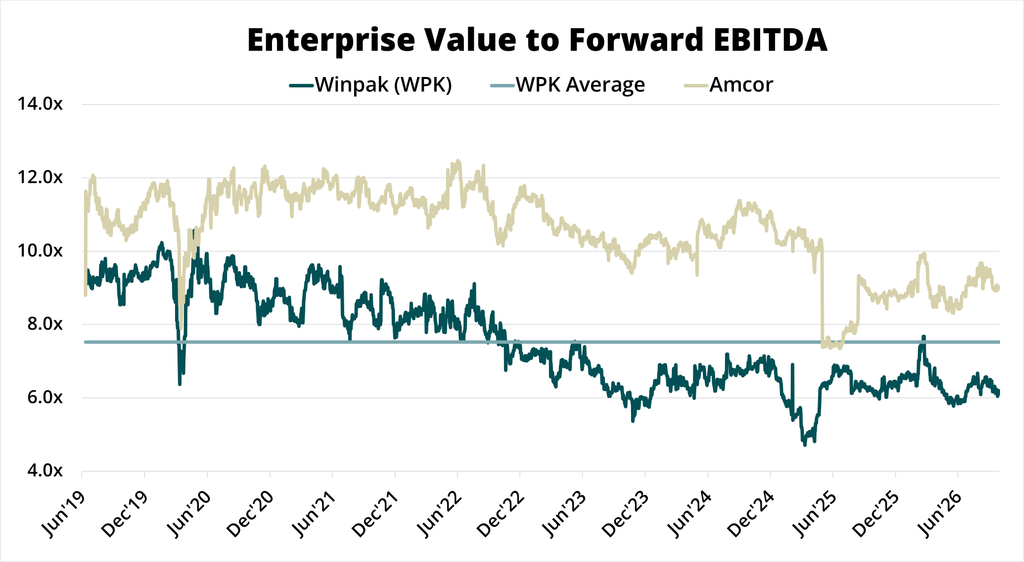
Source: Capital IQ
More generally, we observe a structural discount for small caps that helps contribute to a margin of safety for the portfolio. We have seen this validated in a number of recent takeouts of portfolio holdings at an average premium of ~40%. Similar to Winpak and Amcor, when we compare many of our small-cap portfolio holdings to their large-cap peers, we see a sizeable discount that is not fully explained by other factors like asset quality.
There is also a healthy margin of safety embedded across many of the portfolio risk management metrics that QV focuses on. For example, the portfolio trades at a P/E that is nearly 5% lower than the TSX Small Cap Index, generates a 4-year ROE of 13.5% versus 3.8% (3.6x higher), and carries leverage on a net debt-to-equity basis that is just 64% that of the benchmark. This focus on risk management matters most during volatile markets and has helped the QV Canadian Small Cap Strategy outperform its small cap benchmark in each of the previous 8 market drawdowns since 2002.
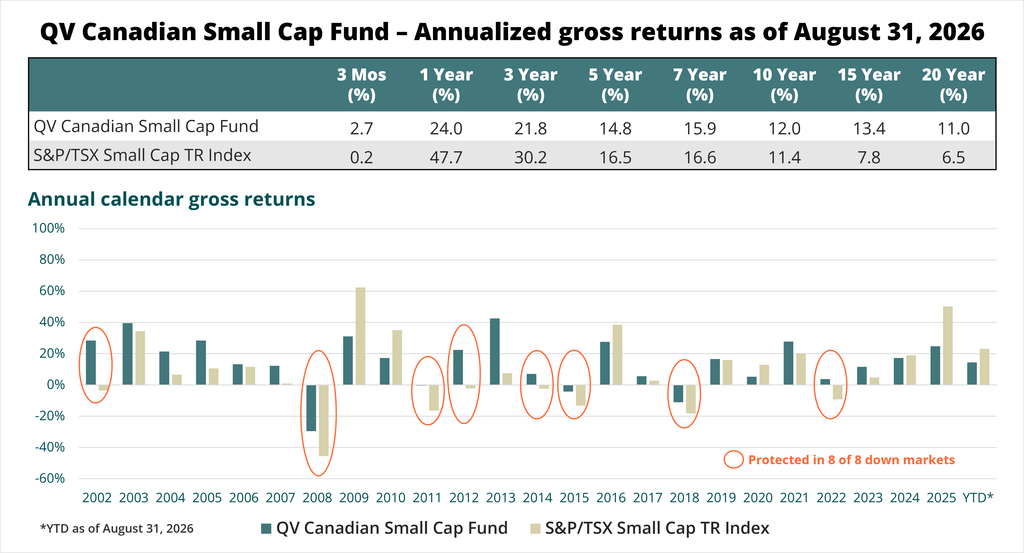
Source: QV Investors