Written by the Fixed Income team: Gennice Spanier and Clement Chiang
In recent weeks, we have been asked about U.S. Treasury yields more times than we can count. These questions are entirely justified, as 30-year Treasuries have sold off since early summer, with yields reaching their highest level in roughly two decades. While there have been many articles dedicated to decoding this move, we would like to offer our interpretations of what is happening and what it means for your portfolio.
Refresher on the Components of Yield
As discussed in the Fixed Income team’s June 2025 letter, the yield curve can largely be broken down into two parts: inflation expectations and real yield. Inflation expectations, as the name suggests, are driven by the market’s interpretation of what inflation will be over a given time horizon. The impact of inflation expectations tends to be more prominent on shorter-maturity bonds while generally less volatile for longer maturities. The second component of yields, real yield, is the expected return above inflation. Real yield encompasses the additional yield required by investors to hold bonds over a longer time period.
What has changed?
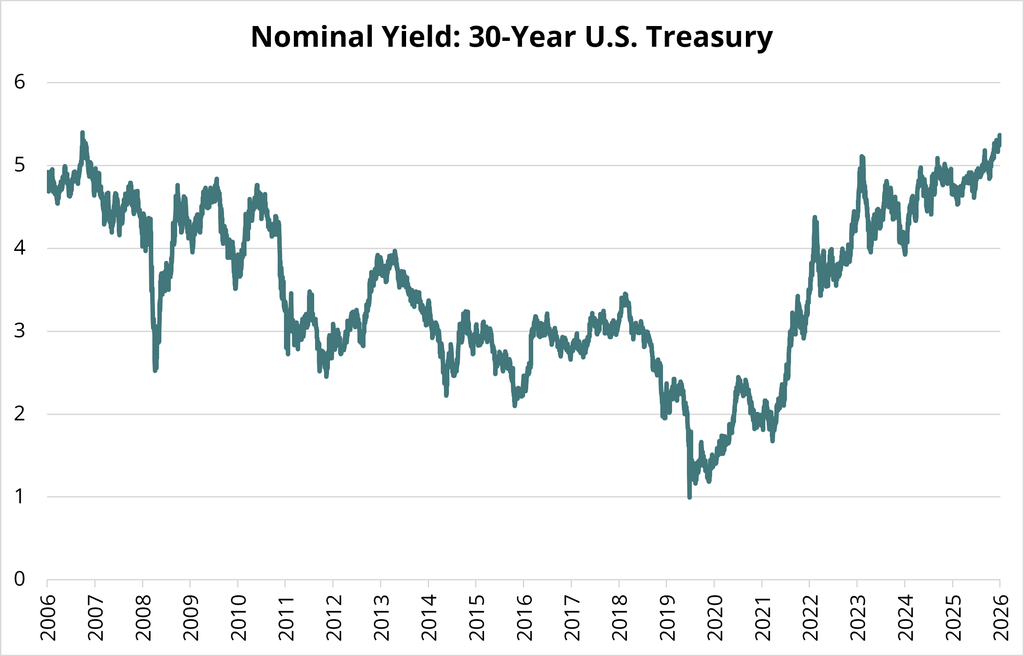
Source: Bloomberg
As shown in the above chart, the nominal yield on a 30-year U.S. Treasury has risen decisively in recent weeks (5.4% at the time of writing).
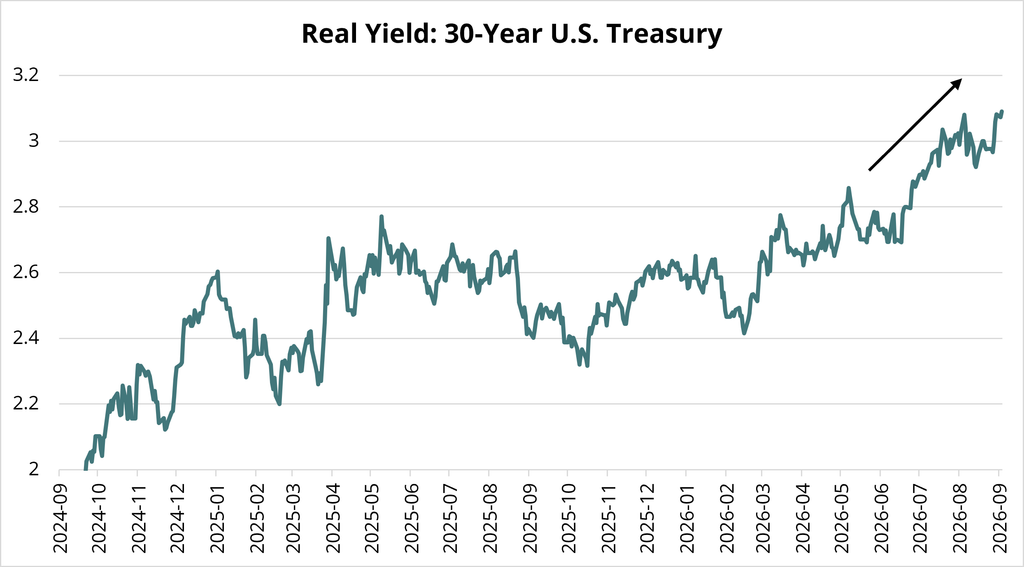
Real yield has been the dominant driver of the increase in yields. This increase is visible in the below chart. Real yields have been on the rise for years, but the recent move to 3.1% pushed long-maturity yields to their highest point in decades.
Source: Bloomberg
Changes at the U.S. Federal Reserve (Fed) have been one of the influences on real yield. Kevin Warsh recently stepped into the role of Fed Chair. At first glance, it does not appear as though he has taken any notable action in his limited time in office, with the Fed Funds rate holding at 3.5%-3.75%. While we acknowledge that the Fed may alter its policy rate at its announcement today, the lack of change to date has called the Fed’s inflation-fighting credibility into question. With the August CPI reading of 3.4%, inflation has remained stubbornly elevated since the pandemic recovery. Lack of action increases the level of risk priced in by the market.
Warsh has, however, been making changes in how the Fed operates. He has eschewed forward guidance, a notable shift for the market given the abundance of forward guidance and transparency provided by his predecessor, former Fed Chair Jerome Powell. Additionally, Warsh has formed 5 task forces to review and advise on changes to the Fed’s existing frameworks and processes. Change can be a good thing; however, in the eyes of the market, these changes equate to higher uncertainty in the Fed’s decision-making, which has added a premium to the long end.
Lack of change can also be considered a source of risk, when negative trends go uninterrupted. U.S. government debt accumulated to a record $40 trillion USD, reigniting market fears about the country’s overextended financial burden. These fears are compounded as the current administration seems undeterred from introducing proposals that would further add to this issue. Trump’s announcement of a $5 thousand “dividend” to all adult U.S. citizens if Republicans win the midterm elections is one of the most recent examples. While the market is not expecting this promise to be upheld, that does not negate the fact that the U.S. fiscal deficit is running at nearly 6% of GDP, a level typically reserved for recessionary periods, when government fiscal injections help cushion against the impact of an economic downturn.
The large fiscal deficit is not only altering investors’ interpretation of the riskiness of U.S. Treasuries but also adding to Treasury issuance levels. These prodigious deals are introducing supply that must be absorbed by the market. This comes at a time when the Fed has not engaged in the quantitative easing of its balance sheet, which is when it acts as a net buyer of U.S. Treasuries. Without the support of large-scale buying from the central bank, U.S. Treasury yields have been pushed higher to entice buyers as additional supply disrupts the market balance.
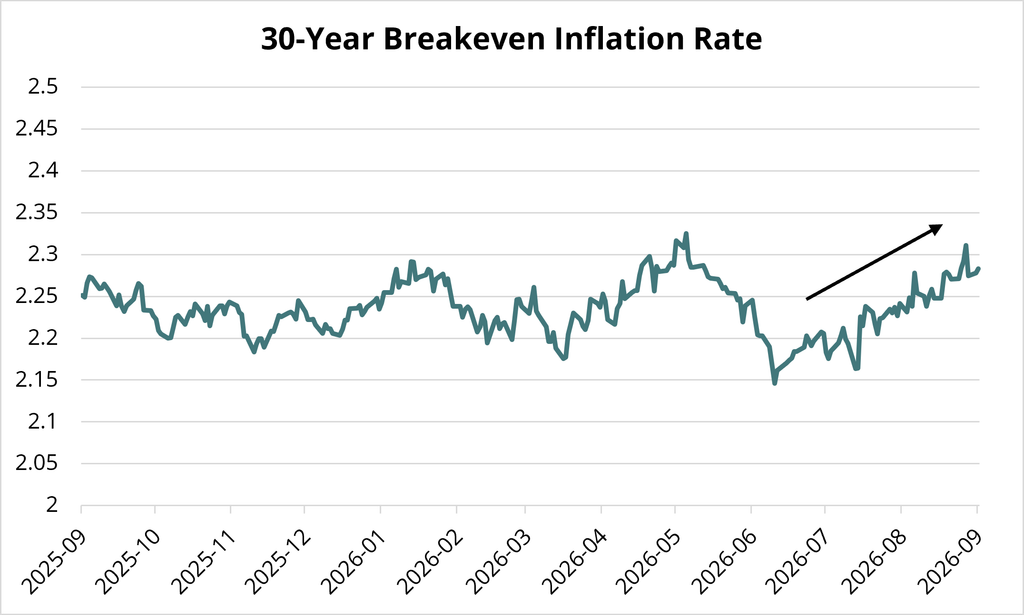
It is not only real yields driving nominal yields higher. Inflation expectations for the 30-year time horizon have also moved up, contributing to the rise in yields to a lesser degree, as shown in the chart below. Inflation in the U.S. has held above the Fed’s 2% target for over 5 years. The war in Iran has introduced new sources of inflation that are supporting the market’s view that price pressures could be higher for longer if the Fed does not take decisive action. Inflation expectations in the long term remain anchored to the Fed’s 2% target, however the slight increase to expectations in the summer months marginally contributed to the trend in higher yields.
Source: Bloomberg
Treasury Secretary Scott Bessent is attempting to control the persistent rise in yields by increasing the amount of bonds the Government will buy back. This introduces an indiscriminate buyer to the market, which should theoretically push yields lower as demand increases. However, the Treasury is not the Federal Reserve; it does not have the money printing ability that a central bank has. Though it committed to purchase at least $4 billion of Treasuries in each buyback, this simply lacks the firepower to cushion a ~$2 trillion fiscal deficit. Ultimately, the impact on yields was minimal, as the market widely recognized this as a Band-Aid fix for a problem that requires fiscal restraint rather than additional spending.
There is not one sole factor that we can point to as the cause for the recent rise in long-maturity bond yields. Rather, it has been the confluence of these forces each playing a role. Although, the impact doesn’t stop with the effect on bond yields. Other market segments have shown spillover effects as well.
Rising Yields: A Double-edged Sword
While perhaps not initially apparent, higher yields can also affect equity returns. Equity market pricing has been pressured in tandem with the rise in long-maturity yields. In recent years, we have observed that at lower yield levels, equity prices rise with bond yields. However, history has shown that this relationship reverses once the yield on a 10-year U.S. Treasury surpasses a 5% threshold. Above this point, equity valuation multiples have tended to falter. This eventual pressure on equity valuations is likely because higher Treasury yields raise the cost of debt for businesses and mathematically force the fair value calculation for stock prices lower. Technically, bonds look relatively more attractive at higher yields, which may layer additional pressure on stock prices. No matter the cause, we have seen equity returns stagnating as yields rise.
All else equal, rising government bond yields are the tide that lifts all boats. This opens more opportunities to invest in both government and corporate bonds at higher all-in yield levels, which also increases the aggregate yield to maturity expected in a bond portfolio. Importantly, fixed income returns are higher going forward, a benefit for long-term investors.
Executing the Plan
Understanding the causes behind the recent increase in yields helps inform our view of market opportunities. The actions of select key individuals in the U.S. introduces risk that can be difficult to predict. Without future clarity, we believe the most prudent approach is to maintain the Fixed Income strategy’s yield sensitivity near that of the benchmark. While the unpredictability of today’s interest rate environment makes it difficult to form a view on future bond yields, it does introduce opportunity elsewhere. With corporate credit premiums holding steady, higher yields have pushed corporate bond yields higher. We are focused on finding opportunities in areas where our fundamental analysis can help inform our decision-making and where we can add to the strategy’s yield advantage on a risk-adjusted basis. Despite what novel and unique dynamics might unfold in the market, our plan of action remains the same: to follow our investment philosophy which has been our north star for nearly 30 years, and take action when our bottom-up analysis leads us to opportunities in any market environment.