
Most retirees want enough reliable, inflation-protected income to cover their basic living expenses. After all, who wants the financing of their basic needs left to the vagaries of the stock market?
With basic needs met, retirees can invest the rest of their savings with confidence and enjoy the experiences that make retirement rewarding.
The problem is that secure retirement income is surprisingly expensive because no one knows how long they’ll live.
In this two-part series, we’ll compare three ways of “purchasing” secure retirement income. Throughout, we’ll consider Elisabeth, a healthy 70-year-old retiree, as our example. She wants to dedicate $100,000 from her portfolio to increase her secure income through retirement, but the amount of guaranteed income she can obtain depends on the approach she takes.
In Part 1 of Secure Income In Retirement, we’ll compare a direct investing approach with purchasing a life annuity. In Part 2 of this series, we will discuss a third option, which you can read about later this week.
Secure Lifetime Income – DIY Direct Investing Approach
If Elisabeth were to directly invest her $100,000 in a portfolio that would provide secure income for life, what’s the maximum amount she can safely withdraw without risking outliving her money?
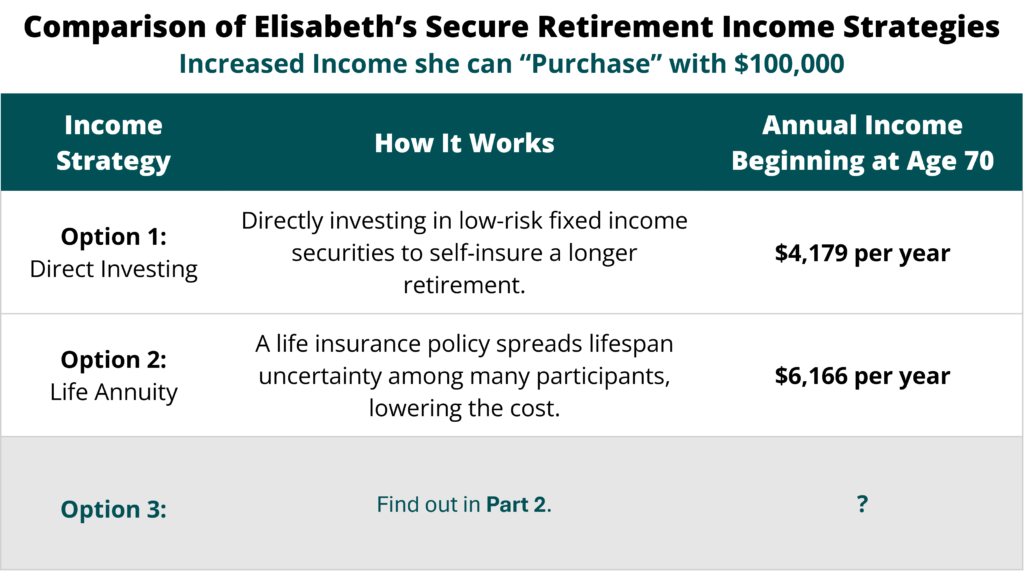
My estimate is just $4,179 per year. Many people would find that shockingly low given Elisabeth’s age and current interest rates. Why so little?
There are two reasons the self-insured amount is so low:
- First, for income to be secure, Elisabeth’s capital must be invested in “safe” assets that have a low chance of default. These assets have relatively low rates of return compared to less secure alternatives.
- Second, and much more important, Elisabeth has no idea how long she’ll live.
Because Elisabeth wants reliable income regardless of market conditions, I’ve assumed her capital is invested in a hypothetical portfolio of provincial bonds, yielding about 4.4% as of June 1, 2026. Provincial bonds are high-quality and offer a premium over Canadian federal bonds due to lower liquidity. Elisabeth will hold these to maturity while benefiting from the higher interest rates.
If Elisabeth wants guaranteed income for life, she can’t plan on living only to her life expectancy, which is around age 90. She must consider the possibility of living into very old age. According to standard mortality tables for Canadian pensioners, that means Elisabeth must plan as if she will live to age 106 if she wants less than a 1% chance of outliving her money.
To maintain spending power over time, her portfolio structure must support withdrawals that grow at 2% per year, in line with the Bank of Canada’s target inflation rate. Actual inflation could be higher or lower, which is why we will revisit inflation protection in Part 2.
Under these assumptions, Elisabeth could spend roughly $4,179 per year, increasing by 2% per year, and be virtually assured she’d never run out of money.
Self-Insurance is Economically Inefficient
The biggest problem faced by Elisabeth in creating her own secure income is that she has no idea when she’ll die, so she must provision for an extremely long life. This is what I call the longevity tax. Likely, Elisabeth will die with a significant amount of unused capital, instead of enjoying a more rewarding retirement.
Using this approach, she is effectively paying $100,000 now to receive $4,179 annually for life, with each dollar of guaranteed annual income costing her about $23.92 today.
Luckily for Elisabeth, this isn’t her only option. There are far more efficient ways to allocate her $100,000 for a more secure retirement, one of which is a life annuity.
Secure Lifetime Income – Life Annuity Approach
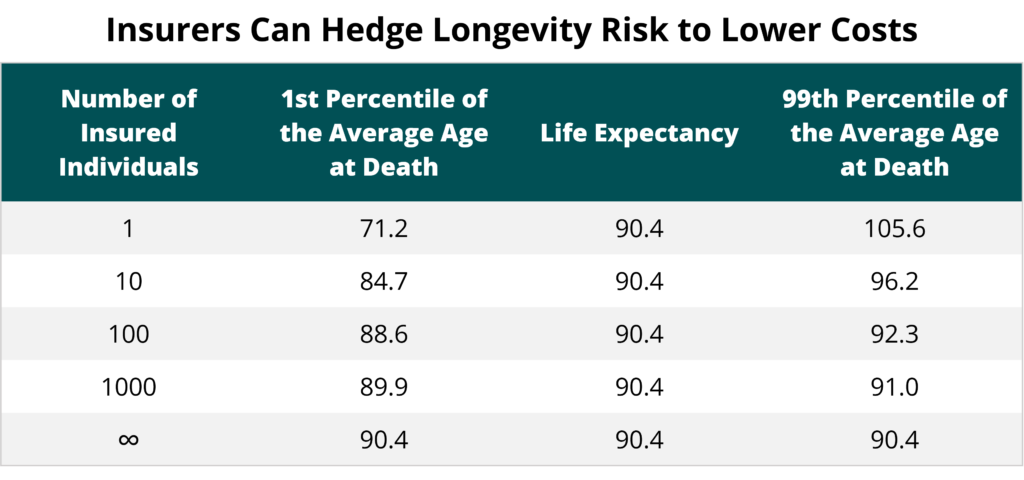
The uncertainty of self-insurance is costly for Elisabeth, but it becomes easier to manage when many retirees are pooled together. Insurers do not need to know when any one person will die; they only need to estimate the average age of death across a large group, which they can do with remarkable accuracy.
Statistically speaking, this is the law of large numbers. As you keep adding more people to a group, the distribution of average outcomes collapses towards life expectancy, with very little variability.
Source: Canadian Institute of Actuaries and QV Investors.
No insurer can know whether Elisabeth will live to 75 or 105. However, if she is in a pool of 1,000 70-year-olds, the insurer can be confident that the average age of death is between 89.9 and 91.01.
As a result, a life insurer can offer Elisabeth $6,1662 per year (growing at target inflation of 2% per year). That’s a 48% improvement over the meagre $4,179 she would have received if she attempted to self-insure her retirement income.
With a lump sum payment of $100,000 today, a life annuity would provide $6,166 per year, and Elisabeth would effectively pay $16.22 today to purchase each dollar of guaranteed annual income.
While this method is a more economically efficient way to create guaranteed retirement income, life annuities are often misunderstood, and the requirement to pay a large upfront premium is both a mental and practical hurdle for most people.
Also important to note is that a life annuity is an insurance contract rather than an investment. It is protected from market losses, but it does not leave any remaining value for Elisabeth’s estate if she were to die earlier than expected, unless she purchases a death benefit for an additional premium. In exchange, however, she would receive insurance against both market risk and the risk of outliving her savings.
The bottom line is that life annuities are a good choice for retirees looking to hedge the financial risks of a very long life. By shifting longevity risk to the party best equipped to manage it, Elisabeth can turn the same $100,000 into more guaranteed income than she could safely draw on her own.
Life annuities improve on the self-insured approach, but they are not the most efficient source of secure retirement income available to many Canadians. In Part 2, we’ll look at why delaying Canada Pension Plan benefits can offer even better terms.
Ultimately, the right approach will depend on your individual financial situation and should be evaluated in the context of holistic financial planning. To determine the best income security approach for your individual circumstances, book a call with a QV Investment Counsellor.
- Insurers include provisions in their pricing to account for adverse deviations (including the possibility their mortality table is mis-specified), other risks, and capital charges. ↩︎
- Illustrative annuity quote as of June 1, 2026 from https://lifeannuities.com ↩︎