
Written by the Global Large Cap Team: Mathew Hermary, Richard Fortin, and Brendan Harrington
Despite a roughly 20% gain for the S&P 500 over the last year, investors may be surprised to learn that dispersion – defined here as the volatility of individual stock prices relative to the broad market – has reached extremes not seen since the dot-com bubble. Historically, this phenomenon has tended to occur during periods when investors struggle to accurately value equities or when broader market leadership is changing.
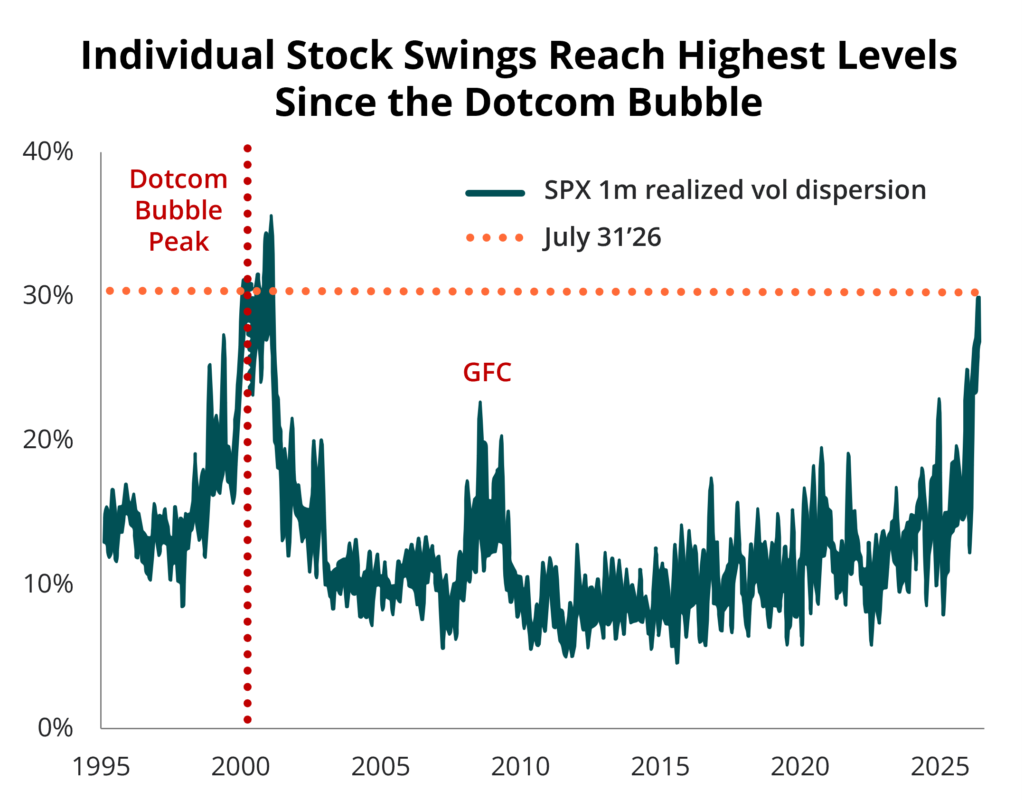
Source: BofA Global Research. Data from 1-Jan-95 to 31-Jul-26.
For fundamental investors like QV, volatility can create opportunities. Within the QV Global Equity Strategy, the unusual turbulence of the last year has helped us to further enhance the quality and diversity of our holdings while preserving a margin of safety.
From Chips to Hyperscalers
The strategy’s exposure across what we broadly define as information technology has evolved materially over the last 12–18 months given relatively extreme volatility in the space. In the first half of 2026, we exited semiconductor wafer fabrication equipment (WFE) businesses Applied Materials and Tokyo Electron, materially reduced long-term holding Samsung Electronics, and allocated incremental capital toward hyperscaler franchises such as Microsoft, Tencent, and Alibaba.
This shift was initially catalyzed by valuation discipline. Unbridled optimism for WFE and semiconductor businesses – the “picks and shovels” providers to the AI gold rush – pushed valuations to extremes, which moderated prospective returns relative to normalized earnings power. For example, in just over a year, Samsung’s price-to-book ratio rose from an all-time low of 0.8x in May 2025 to a June 2026 peak of approximately 5x as the memory industry entered its most severe shortage in more than four decades, driven by overwhelming demand from AI data centers.
Conversely, as investors bid up valuations in memory and WFE to historical peaks in pursuit of high current growth rates, hyperscaler valuations significantly compressed over concern related to the size of their data center investments. We subsequently re-initiated a position in Microsoft at a multi-year low valuation in April, after having previously sold it in 2020 at nearly 35x price-to-earnings, following a decade of prior ownership. We also added to businesses like Alibaba at similarly depressed valuations.
Beyond valuation, fundamentals were a key determinant in the decision, as despite the unprecedented profits being enjoyed in WFE and memory, we believe durable long-term value should ultimately accrue to the hyperscalers given their strong customer captivity, unmatched financial resources, and increasing vertical integration.
From a strategic perspective, hyperscalers are leveraging enterprise lock-in and high switching costs within traditional cloud computing to position AI as a seamless add-on rather than an entirely new platform. This incumbent advantage may make them among the few participants able to justify the substantial capital required to scale AI compute. It also supports their rationale for vertical integration, which most notably can deliver improved system performance, efficiency, and security while also reducing reliance on external infrastructure providers. In turn, this could allow them to capture a meaningful share of recurring AI revenue at attractive margins.
Potential Cyclical Inflection in Quality European Industrials
Following over two years of cyclical downturn among many European industrials, several of our investments have begun to show signs of durable improvements in demand among customers spanning aerospace and defense, transportation, public and social infrastructure, and energy.
Instalco, a Nordic-based heating and plumbing installer, saw its order backlog rise 17% in the second quarter. Andritz, an Austrian hydroelectric and pulp-and-paper equipment manufacturer, saw order intake rise 25% in the first half of 2026. Alten, a French engineering and technology consultant, saw quarterly organic growth rise to 3% following two years of cyclical decline. Our positions in these investments were built during periods when cyclical headwinds were evident and valuations were low relative to historical averages, with the most recent addition to Instalco in February. We think patience and selective increases to our positions through the recent down-cycle and last year’s volatility should be rewarded as fundamentals improve and earnings recover.
Managed Care Recovery Taking Shape
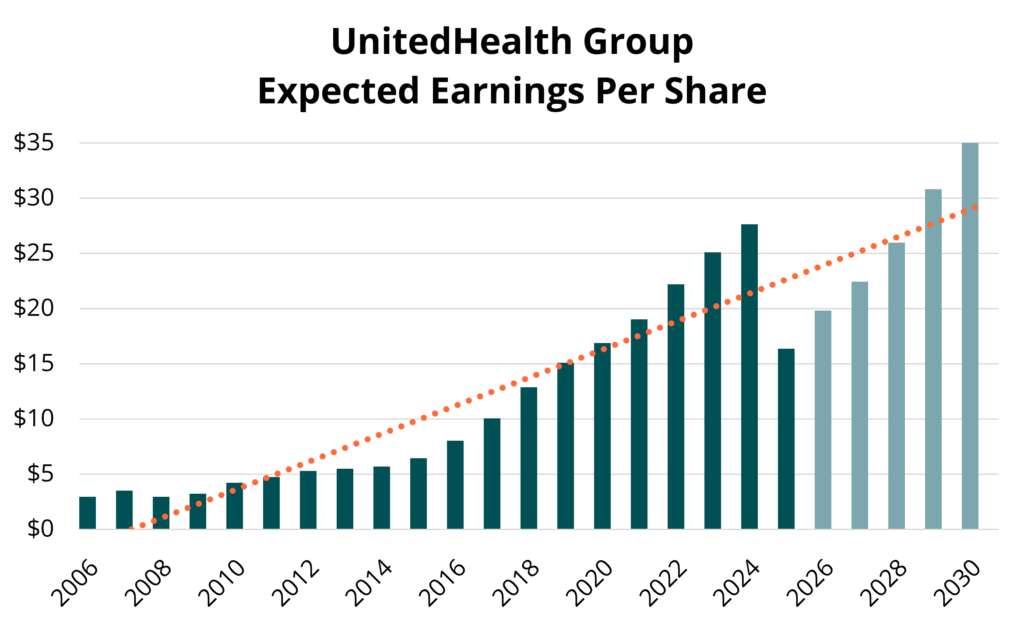
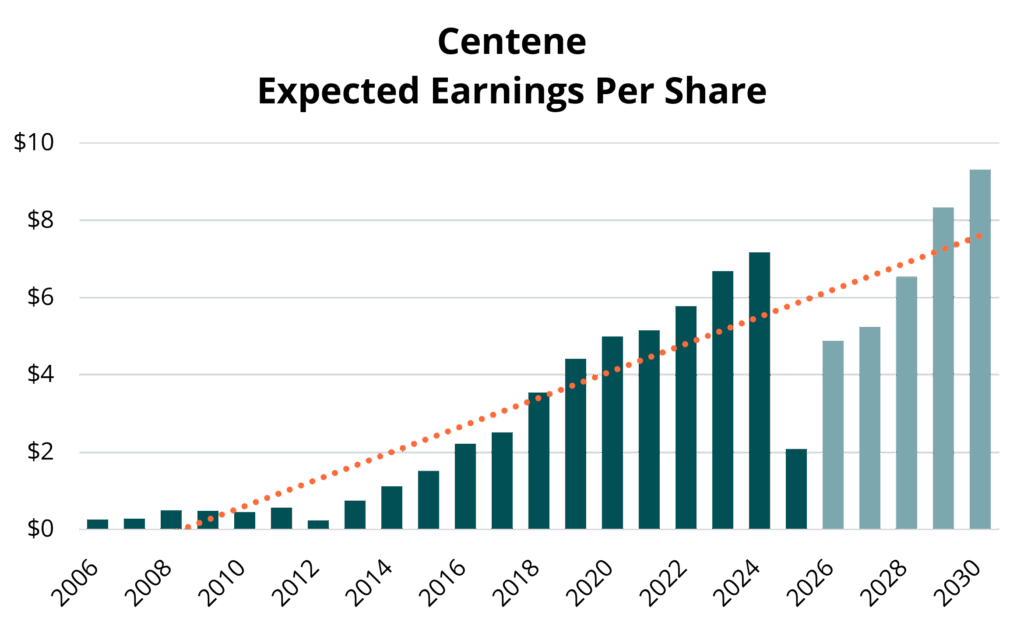
The strategy has continued to retain a large allocation to healthcare in 2026 – partly through managed care holdings UnitedHealth Group and Centene. Managed care providers are emerging from one of the most challenging periods in their history. As the industry exited the pandemic following a period of outsized profitability, several headwinds converged to compress sector earnings and re-price the space to multi-year valuation lows during 2025.
For UnitedHealth Group, the largest Medicare provider in the US, deferred procedures returned in greater volumes than anticipated after the pandemic, bringing later-stage diagnoses and materially higher acuity levels into the healthcare system. The resulting medical cost inflation and inability to recapture these costs through pricing adjustments was the single largest contributor to the company’s 40%+ earnings decline in fiscal 2025. Although Centene’s challenges were different in nature (Medicaid redeterminations and worse-than-expected marketplace morbidity), they produced the same results: a sharp rise in medical costs and an even steeper 70% collapse in fiscal 2025 earnings.
Today, a more constructive pricing environment has taken hold. Government payment rates to insurers are now growing faster than underlying medical costs, while recent hospital data indicates that patient volumes are normalizing, contributing to a more favorable revenue-versus-cost dynamic. Collectively, these factors point to the start of a new earnings cycle for managed care. In fact, over the past few weeks, both companies posted strong fiscal Q2 results that were well ahead of investor expectations, with upward revisions to their respective 2026 outlooks. In our view, this corroborates the recovery currently underway.
Source: Capital IQ, QV Investors
Source: Capital IQ, QV Investors
Despite year-to-date gains of 22% for UnitedHealth and 56% for Centene, neither franchise trades above its long-term average valuation on normalized earnings – while the S&P 500 is near record highs and carries significantly more valuation risk. However, no opportunity is without risk. The US healthcare system remains heavily dependent on government funding against an increasingly difficult fiscal backdrop, and the upcoming midterm election could create undue volatility through negative policy headlines. Nonetheless, we expect the combination of attractive value and a structural earnings recovery to produce an attractive outcome over the next three to five years in managed care.
Prices Change but the Strategy Does Not
While many areas of the opportunity set have shifted rapidly over the last year, the long-term game plan has not. Valuation and downside protection remain in focus as the QV Global Equity Strategy continues to trade near its long-term average price-to-earnings ratio (P/E) and near a record discount to the broader market.
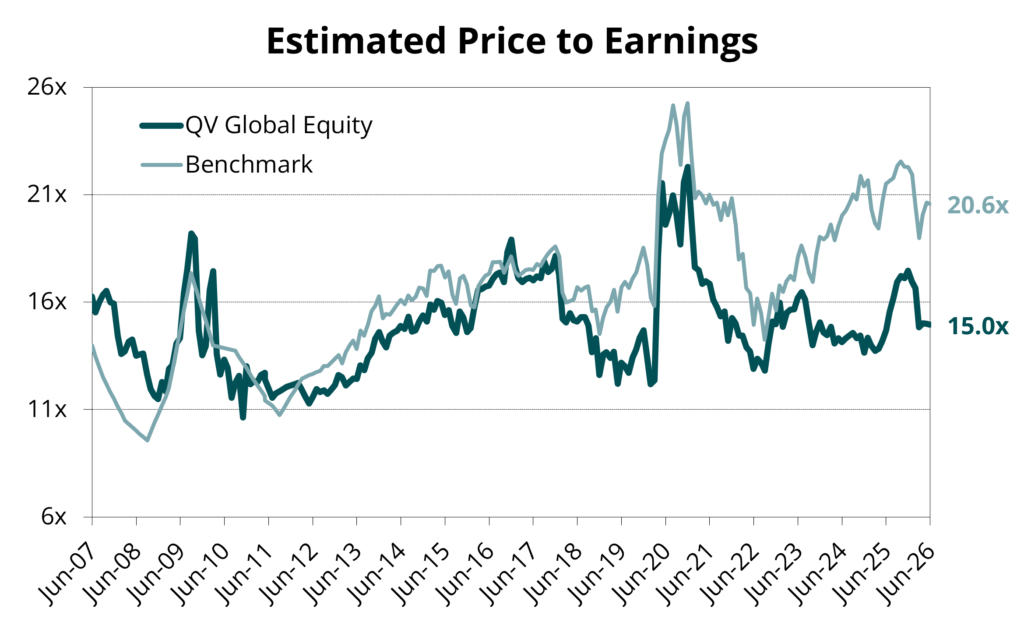
Source: Capital IQ, QV Investors
Five to ten years ago, in a world of low real interest rates, investors were willing to pay extremely rich multiples for the highest quality businesses, particularly those that were generating above-average revenue growth. In recent years, many of these valuations have significantly compressed due to factors such as:
- the subsequent rise in interest rates and inflationary pressures since 2020;
- the empirical tendency for above-average corporate growth rates to revert toward that of the broader economy; and
- the recent spike in individual stock volatility, driven in part by investor capital flows shifting towards AI themes and away from other areas of the market.
As a result, we have found it much easier to identify and own very high-quality businesses at increasingly reasonable prices. The strategy’s current return on equity (ROE), a representative trait of quality, is 21.4%, the highest since 2007. In addition to the strategy’s valuation advantage, improving franchise durability and earnings growth persistency should provide an incremental margin of safety for the future.
While a crude measure, we can combine valuation and quality into a single ratio by dividing the P/E of the strategy by its ROE to approximate how much we are paying for ‘a unit of quality’. A lower P/E-to-ROE ratio can therefore suggest a more attractive balance between price and quality.
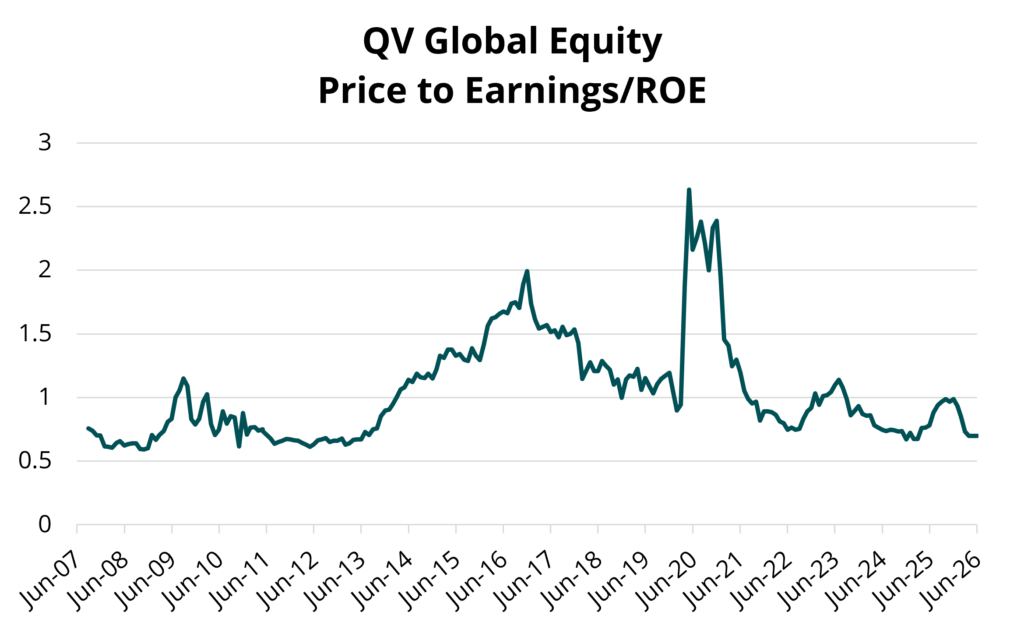
Source: Capital IQ, QV Investors
This quality-adjusted view helps bring the broader opportunity into focus. The result is a portfolio with stronger profitability characteristics, but without a corresponding increase in valuation – a balance that is especially important today.
In contrast to a highly concentrated market driven largely by a single theme, and where elevated current valuations depend on favorable outcomes in a rapidly changing environment, we think the QV Global Equity Strategy’s more diversified basket of businesses offers a sensible alternative.
Written by the Global Large Cap Team: Mathew Hermary, Richard Fortin, and Brendan Harrington