QV’s Global Small Cap Strategy returned 23.6% in 2025. While we are pleased with this one-year result, we also derive a sense of caution as to the sustainability of such a return level. On an aggregate basis, the strategy saw its valuation multiple on a price-to-earnings basis expand by ~9% throughout 2025 to end the year at 16.3x. Therefore, when we begin to disaggregate the return drivers during the year, we can see that, absent the valuation expansion, the other drivers of return contributed ~15%. This includes a dividend yield for the strategy, which averaged just over 3% during 2025, implying earnings per share growth contributed ~12% to returns in 2025, which is a reasonably healthy rate of absolute growth. The companies we invest in can control their capital allocation priorities, which include how much capital to return to shareholders. Therefore, the dividend component of return is controllable by us as we select companies with the capital allocation priorities we want to be aligned with. Earnings growth, to some degree, is controllable by our strategy holdings as well through the growth strategies they choose to execute on. Capital allocation is a fundamental consideration here too, as companies can decide whether and how to deploy cash flow to drive incremental earnings growth. Of course, there are other cyclical and perhaps structural dynamics at macro-levels that are outside of management’s control and can affect earnings trajectories. Unequivocally, the element of return that is outside of our control is the valuation multiple expansion or compression, as we have no control over the change in market prices. Of course, we can get the valuation expansion odds on our side by buying at what we believe are favourable discounts to intrinsic value (hence the concept of margin of safety), but we still do not control the resultant valuation change.
In reflecting on the performance of the strategy in 2025, clearly valuation expansion was a material driver. Numerous holdings saw material valuation expansion, including Beijer Alma with +47% expansion in its price-to-earnings valuation; in other words, market participants were willing to pay 47% more for a dollar of Beijer Alma’s earnings. Similarly, Computacenter saw +44% price-to-earnings expansion, Aritzia +46%, and Games Workshop +25%. The implication is that the ‘starting point’ from a valuation perspective at the beginning of 2026 is less favourable as a driver of prospective returns than it was a year ago. We were recently posed a question from a colleague at an Investment Committee meeting enquiring how we think about handling holdings where valuation may have expanded in a short timeframe. In the spirit of Kenny Roger’s well-known song, The Gambler, in poker you have to consider whether it still makes sense to hold a hand, just as in investing you need to assess whether it makes sense to keep holding a stock.
Pulling out the Flowers and Watering the Weeds
The decision on how we approach short-term valuation oscillations in strategy holdings is a part of the ‘art’ of investing. We are reminded of one of Peter Lynch’s ’20 Golden Rules’ that he wrote about as concluding lessons in his book Beating the Street. One of these Golden Rules was: “Often, there is no correlation between the success of a company’s operations and the success of its stock over a few months or even a few years. In the long term, there is 100% correlation between the success of a company and the success of its stock. This disparity is the key to making money; it pays to be patient, and to own successful companies.” Lynch expands on this thinking when he discusses his early days running the Magellan Fund and the seller’s remorse he felt from having moved on from good companies too quickly to chase the next thing (i.e. pulling out the flowers). Lynch emphasizes that sticking with some of these stocks longer would not have been ’unconditional loyalty’ but instead would have been staying the course with companies getting more attractive. In the QV Global Small Cap Strategy, we keep the above in mind when facing holdings with valuation expansion. We perform careful analysis of the business’s fundamentals and particularly assess whether outcomes are tracking towards our investment thesis for a particular holding.
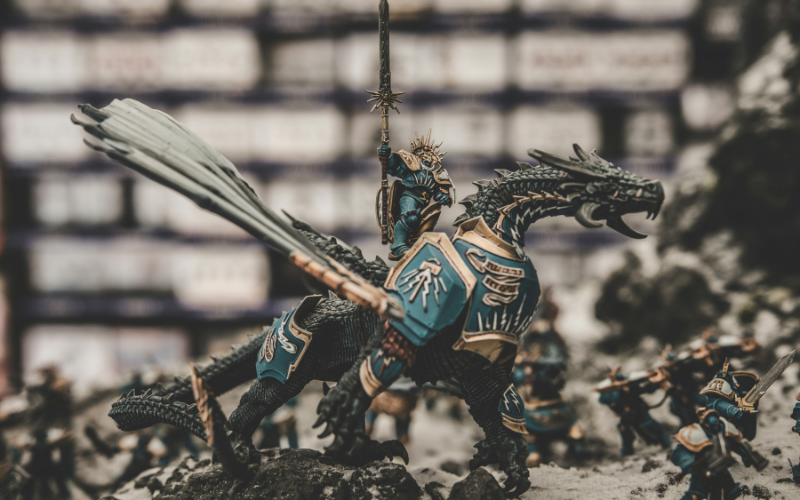
We can look at our experience with Games Workshop as an instructive example. Games Workshop is a niche UK hobby company producing a tabletop game called Warhammer. The company has developed and owns the intellectual property surrounding the science-fiction universe of the Warhammer franchise, which has been cultivated over 40 years. To support gameplay, they also produce plastic miniatures which are collected, painted and used by hobbyists to play the tabletop game associated with the Warhammer franchise. This is a high-quality company by several fundamental measures: it generates high margins (~40% operating profit margins), has a debt-free balance sheet and generates a return on equity over 60%. We bought Games Workshop in the QV Global Small Cap Strategy in the fourth quarter of 2022, when valuation on a price-to-earnings basis was ~16x. Valuation has since expanded to over 30x on a price-to-earnings basis. However, in the spirit of Lynch, it is important to consider how Games Workshop fundamentally performed over the same timeframe and whether it is poised to continue being successful and thus warrants patience. In 2022, Games Workshop generated GBP 3.91 of earnings per share. In fiscal year 2025, the company generated GBP 5.95 in earnings per share; a growth rate of 15% annualized over the last 3 years of our ownership. The balance sheet remained exceptionally clean over the last 3 years, and at the same time return on invested capital expanded from ~38% to ~53%, indicative of stronger returns on incremental capital deployment.
Fundamentally speaking, Games Workshop has performed well. Do we think this is poised to continue? The hobby appears to be in good health. Independent trade-store customers continue to stock the Warhammer franchise, as it is an ‘anchor-product’ bringing hobbyists into their stores. Games Workshop appears to have a considerable runway for building this distribution further by adding more independent trade account customers that will stock the product. This includes continuing to grow the hobby outside of the traditional UK market; North American sales are hitting stride, growing 47% cumulatively since we purchased the stock in 2022. Games Workshop is also working with Amazon on the production of a TV show that will be based on the Warhammer franchise. There is the possibility of a halo effect from this TV series release that could accelerate interest in the franchise even further.
When we take these developments together with the underlying quality of the business, we are hesitant to fully exit a holding such as Games Workshop when the market price may temporarily exceed intrinsic value. We opt to instead manage this valuation risk through a lower weight in the holding, with the expectation that, barring no new materially negative developments in the fundamentals of the business, we are willing to rebuild weight at a price that may reflect a greater margin of safety. We are cognizant that the entire portfolio cannot necessarily look this way, or else we would be taking too much aggregate valuation risk, and therefore we are still continually looking for alternatives to best assess our opportunity cost.
Velkommen to the Nordics
In the spirit of being on the lookout for great businesses trading at high margins of safety, I spent the first two weeks of the year in Denmark and Sweden where I attended a conference consisting of many small cap Northern European companies. I had the opportunity to meet directly with the management teams of numerous companies, while listening to presentations from many more. I left with a renewed sense of the depth and breadth of opportunities in the small cap Northern European market. I also had the opportunity to meet with existing holdings from the region, including Royal Unibrew, the Danish multi-beverage producer, and Europris, the discount variety retailer with chains in Norway and Sweden (under the ÖoB brand name). In addition to very constructive meetings with the management teams of both companies, I got to tangibly interact with the offerings of both. I drank Royal Unibrew’s ‘Faxe Kondi’ soft drink and explored the offering of an ÖoB store in Sweden. While this experience is anecdotal and I had no intention of changing the ownership position in Royal Unibrew based on whether Faxe Kondi appealed to my taste buds, it was useful to confirm for myself things that I had only been able to read previously as an investor based in Canada. For example, in addition to Faxe Kondi, Royal Unibrew has the rights to produce and market Pepsi-branded products in Denmark. Combined, both Faxe Kondi and Pepsi’s share of the Danish soft drink market rivals that of Coca-Cola! When I stared into the refrigerators in the convenience store, I could see this being verifiably true with my own eyes; at eye-level in the fridge, there were rows of Faxe Kondi, front and center. While again I restate that the experience is anecdotal, it was nevertheless valuable in continuing to reinforce and build an understanding of owned companies and the investible universe at large.
The QV Global Small Cap Strategy benefits from the compounding of high-quality owned businesses bought at discounts to intrinsic value, and we continue to be on the lookout for more of the same.