
Many global equity markets are near record highs, which can make deploying additional cash feel uncomfortable. It is natural to wonder whether you have missed the opportunity, or whether investing today means buying just before a pullback. Holding onto extra cash may provide peace of mind, but this comfort can come at a financial cost.
Investing at all-time highs
Should you be wary of investing at all-time highs? The data suggests otherwise.
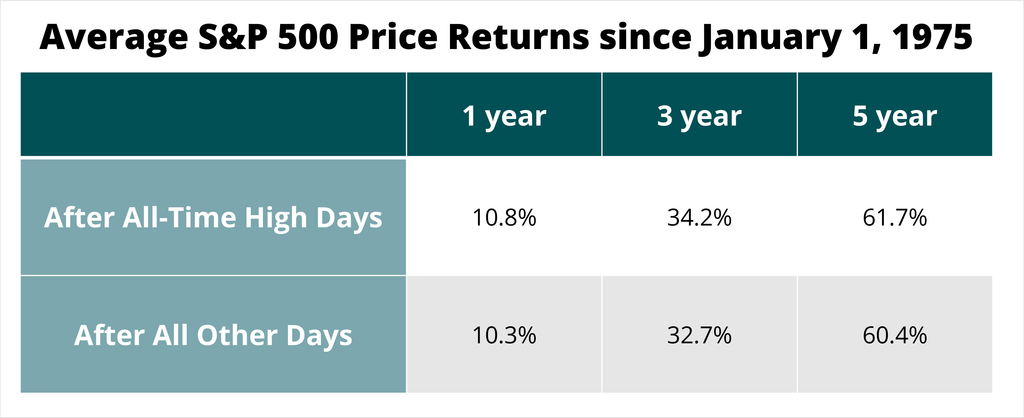
Counterintuitively, investing in the S&P 500 at all-time highs has led to superior returns at 1-, 3- and 5-year horizons, compared to investing on all other days. “All other days” include flat markets, bear markets or otherwise unremarkable markets that, on average, result in slightly lower investment returns.
Source: Bloomberg, QV Investors
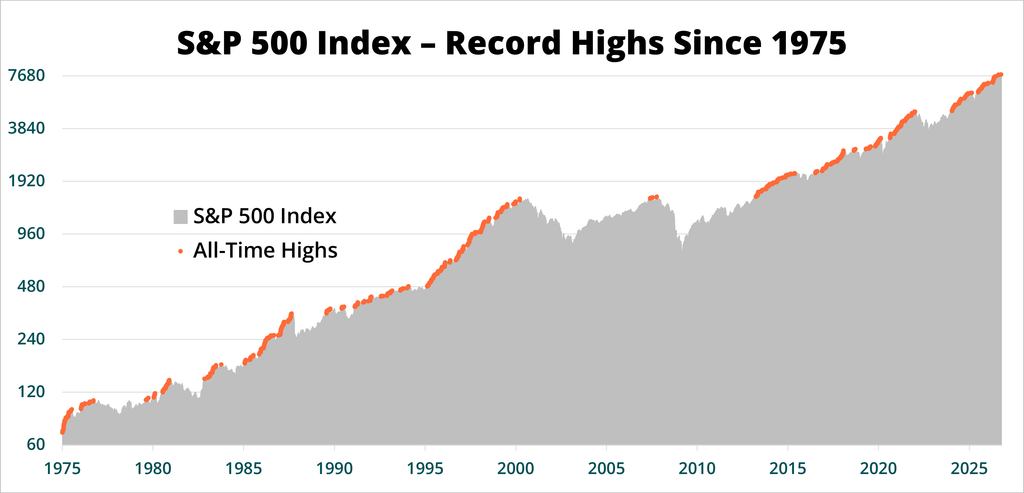
All-time highs are somewhat rare, having occurred on about 8% of all trading days on the S&P 500 going back to 1975. As the next chart illustrates, all-time highs tend to cluster, sometimes for many years. They can be indicative of a secular bull market, with returns historically strongest during these periods.
Source: Bloomberg, QV Investors
This result is counterintuitive because we are trained to think of successful investing as buying low and selling high. It’s true that the most spectacular market drawdowns over the past fifty years were immediately preceded by all-time highs. But these drawdowns have only occurred after a very small percentage of all-time highs – most are followed by a long string of more all-time highs.
The lesson is not that investing at all-time highs is easy or without risk. Successful investing depends on staying invested over time, rather than finding the perfect entry point. Waiting for a better time to invest may feel safer, but it may mean missing periods of strong performance that help drive long-term returns.
Redeploying cash later, when markets feel safer
When people hold additional cash to alleviate anxiety, they may be implicitly assuming there will be an opportunity to deploy it later under more favourable market conditions. In the meantime, cash on the sidelines is capital that is not participating in the market, making patience itself a decision with consequences.
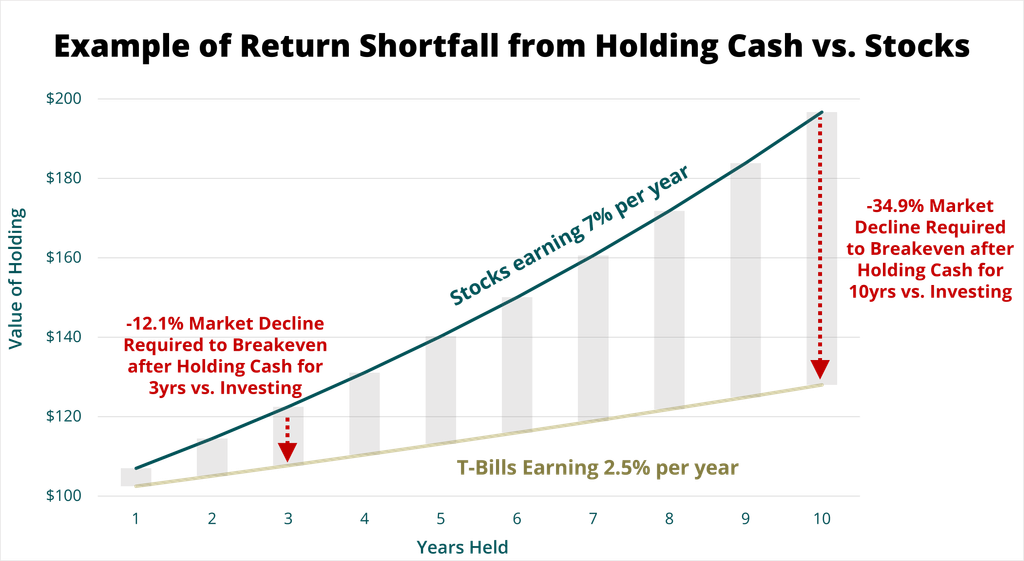
The following table demonstrates this opportunity cost: the stock market returns you potentially give up while you wait for better market conditions.
To put the potential cost of waiting into perspective, consider a simple example. Given $100 in cash, I’ve assumed that cash is parked in T-bills, earning 2.5% per year, and that stocks have a long-term expected return of 7% per year1. The shortfall represents the market correction that would be required for a cash-hold strategy to simply break even, given the opportunity of staying invested.
Source: QV Investors
For example, if you held cash for three years while waiting for a correction, you would only earn about 7.7%, instead of nearly 22.5% in stocks. You would need a 12.1% market correction at the end of year three just to break even with T-bills. Even worse, if your cash was in the bank earning zero, you’d need an 18.4% correction to break even with cash.
This breakeven framework, of course, assumes you would actually be willing to pull the investing trigger if such a correction occurred. But if caution led you to hold cash in the first place, summoning the confidence to buy as markets fall may be easier said than done.
In my 25 years of working with investors, I’ve learned there can be a meaningful difference between the amount of risk we think we are comfortable taking and how that risk feels when markets are actually falling. It is easy to say today that we would gladly buy after a 20% correction. It can feel very different when that day arrives.
Investors who successfully deploy cash after a big correction typically have a disciplined buying plan established well in advance. Even then, pressing the BUY button may still feel deeply uncomfortable.
There is also a cost that is harder to quantify: the constant psychological burden of questioning when to invest. Putting the cash to work means accepting that there may never be a perfect moment and removing the burden of continually trying to identify the right entry point.
GICs reduce your flexibility to invest
For investors who cannot afford to take any risk, GICs can be a good fit. In a balanced portfolio, however, liquidity can be just as important as earning a little more interest. Locked-in GICs reduce your flexibility to act on market opportunities, such as buying after a 30% drawdown in the stock market.
Highly liquid money market investments, such as T-bills, allow investors to keep their cash working while preserving the flexibility to put that money to work when opportunities arise. When markets fall and attractive investments become available, having access to cash can be especially valuable.
Follow your strategic asset mix
The best way to deal with investing anxiety is through your strategic asset mix. Your asset mix should reflect both your goals and the amount of volatility you can live with. If your equity exposure leaves you wanting to hold extra cash or sell after a market decline, that may be a sign that your target mix is too aggressive.
A balanced portfolio gives up some growth potential in exchange for a smoother ride. That tradeoff can be worthwhile if it helps you stay invested when markets inevitably become uncomfortable. Ultimately, the best portfolio isn’t one that looks optimal on paper. It’s the one you can stick with through different markets, then rebalance according to plan.
If you’re still uncomfortable, let’s talk about whether your target mix and cash needs are right for you. Book a free portfolio review with me through Calendly.
- Please note that this data does not consider taxes, so it would be most directly applicable to registered accounts such as TFSA’s and RRSP/LIRA’s. ↩︎