Everyone knows what happens at the end of Aesop’s fable, The Tortoise and the Hare. Through patience, discipline and persistence, the tortoise eventually crosses the finish line victorious. But nobody ever asks what happened after.
I know what you’re thinking right now. Here we go. Another “with time and patience and a disciplined investment strategy, you too can become the tortoise!” (insert eye roll).
Wrong. I mean, right, but not where I’m headed.
What if the tortoise didn’t stop? What if, despite winning the race, he simply kept going because running was all he’d ever known? It was the comfortable thing to do. No stopping to enjoy the moment with fellow tortoise friends, his tortoise wife, children and grandchildren. No opportunity to hoist the trophy and reflect on what he had accomplished. Just. Keep. Running.
It’s an interesting parallel to retirement. Many successful individuals have spent decades working, saving and investing toward financial independence. Yet when they finally reach that milestone, some feel reluctant to stop working or begin drawing on the wealth they’ve accumulated. “Can I really afford to retire?” is a more common question than you think, and if you’re approaching retirement, you may be asking yourself the same thing.
Good Habits Build Wealth
Building the kind of wealth that can support a long and happy retirement rarely happens overnight. For most people, it’s the result of decades of hard work, disciplined saving, prudent investment decisions and maybe even a little delayed gratification. In other words, successful investors tend to be rather tortoise-like.
Along the way, financial success becomes associated with earning more, saving more and watching investment portfolios grow. And let’s face it, there’s something deeply satisfying about seeing decades of hard work pay off when you look at your account balances.
But retirement changes the equation.
Instead of contributing to investment accounts, you’re expected to begin withdrawing from them. Instead of relying on a regular paycheque, you increasingly depend on your accumulated wealth to provide income. And instead of watching your portfolios grow year after year, you may actually see your balances decline over time. Gasp!
For someone who has spent 30 or 40 years building financial security, that transition can be surprisingly uncomfortable.
And therein lies the irony. The very habits that helped create financial independence can make it difficult to embrace it.
So, When Is Enough Really Enough?
It’s a fair question, and a surprisingly hard one to answer. Part of the struggle is that most of us have never determined where our own finish line actually is. Without that, determining how much is enough can be remarkably difficult.
According to BMO’s 2026 Annual Retirement Survey, Canadians believe they need an average of $1.7 million to retire comfortably.
Well, there you have it. Retirement solved. Finish line determined. You have enough. (My turn to insert eye roll here).
If only it were that simple.
The trouble with averages is that they’re wonderfully convenient and often quite useless. A case in point is how the current $1.7M stacks up against previous years. Why is the current figure less than it was in 2022? Or almost $200,000 more than only two years ago? Your guess is as good as mine. That $1.7 million has moved considerably from one year to the next, and it’s unlikely that retirement itself changed that much.
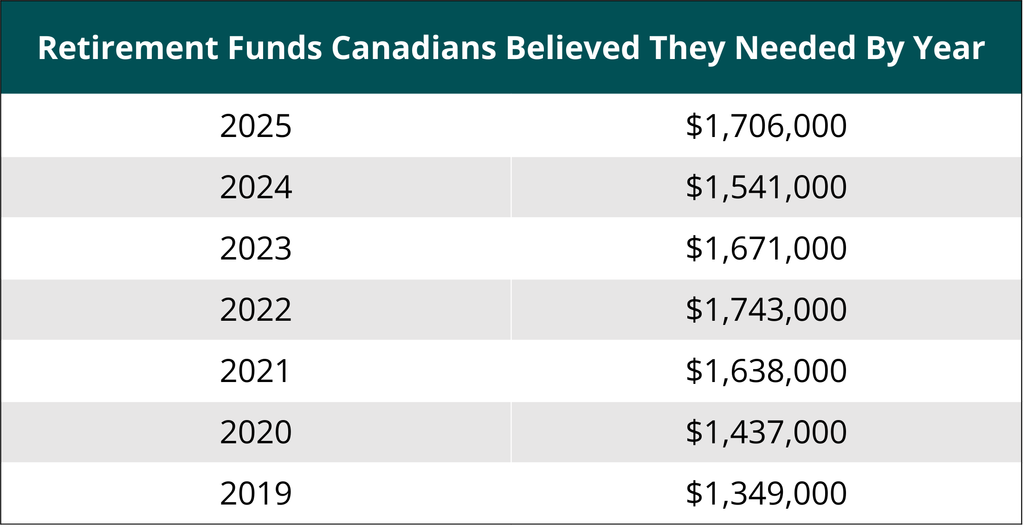
Source: BMO Financial Group, as of November 2025.
Then, there’s the simple difference of where you live within Canada.
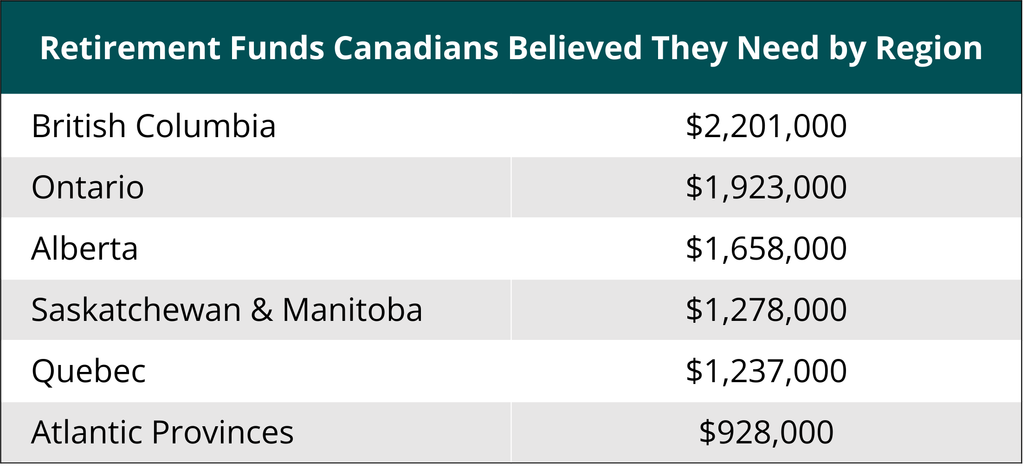
Source: BMO Financial Group, as of November 2025.
After all, there’s no universal price tag on financial independence. A comfortable retirement in Victoria, B.C. (Bring Cash!) might look considerably different from one in Atlantic Canada. And the person dreaming of travelling six months a year probably has a different budget than someone whose idea of adventure is finding a new coffee shop. (For the record, as a former coffee business owner, there is nothing, and I mean nothing, wrong with finding new coffee shops.)
For someone planning a modest retirement, $1.7 million might provide more than enough to meet their spending goals. For someone with different lifestyle expectations, family obligations or financial commitments, it might not come close.
Neither person is necessarily right or wrong. They’re simply planning for different retirements. Their own retirements.
The point isn’t whether $1.7 million is a lot of money. It is. The point is what is enough for one may not be enough for another.
Unlike the race in Aesop’s fable, retirement doesn’t come with a clearly marked finish line. We have to determine where that line is for ourselves.
Finding Your Finish Line
So how do you know when you’ve accumulated enough?
Unfortunately, there’s no magic formula. And despite what the headlines might say, I would suggest that the answer probably isn’t $1.7 million. But you can find it.
It starts with a surprisingly simple question: What do you actually want your retirement to look like?
From there, the conversation becomes much more practical. What will your lifestyle cost? What income will you receive from pensions or other sources? When is the best time to draw on those income sources? How much income will your investments need to provide and for how long? How will taxes, inflation and market fluctuations affect those numbers over time? Obviously, this is not a comprehensive list, but you get the point. It involves a personal discussion with a professional to help you sort through the numbers.
At QV Investors, we help clients understand how their investment portfolios fit within their broader financial circumstances and retirement goals, providing clarity around the decisions that matter most.
Of course, knowing where your finish line is and actually stopping when you get there are two very different things. There’s nothing wrong with continuing to work, building a business or pursuing new ambitions. But there’s an important difference between choosing to keep running and believing you still have to.
And that brings us back to our tortoise.
After all those years of putting one foot in front of the other, perhaps stopping was the hardest part of the race.
Then again, maybe he just needed someone to tell him he had done “enough”.
Are you approaching retirement but uncertain whether your investments can support the lifestyle you’ve worked toward? We can help you find your finish line.
At QV Investors, we help individuals and families make informed investment decisions within the context of their broader financial circumstances. Our disciplined investment approach, with its emphasis on capital preservation and downside protection, is particularly well suited to individuals approaching or enjoying retirement.
If you’re considering retirement and would value a fresh perspective on your investment portfolio and retirement income strategy, I’d welcome the opportunity to connect.